
Jail Roster data for Kane County lets families and attorneys see booking timestamps, charge details, bail amounts, and current custody status without leaving home. The online portal updates daily, showing inmate facility assignments, transfer notes, and release dates, while excluding juvenile files to protect privacy. Users can verify identity with booking number or inmate ID, and the system flags recent intakes that may lag behind official records, helping you pinpoint the most current information.
Jail Roster search tools also reveal how often the county publishes its detention list and what steps are needed for offline record requests. If a recently released individual still appears, the roster’s removal timeline explains the delay, and support staff can assist with verification of inmate roster entries. By understanding public availability rules and common FAQ topics, you can quickly navigate the Kane County jail inmate list and obtain reliable booking reports.
How to Search Jail Roster
Jail Roster search for Kane County begins on the Sheriff’s Office Corrections and Custody page. For public reference, official current inmates listings indicate that it helps a requester locate an adult detainee entry by name, booking number, or inmate ID and check the identifiers and custody fields shown by the jail. The roster is a dated detention list, not a full criminal-history search, mugshot gallery, or live movement tracker. Its practical purpose is to narrow the search to one booking record and show what the county lists at the time of publication.
Official Search Portal: https://www.kanesheriff.com/Pages/Corrections-Menu.aspx
Steps to Search
- Open the official Corrections and Custody page, then select the Adult Justice Center/Jail or inmate lookup option.
- Enter the inmate’s name, booking number, or inmate ID. A booking number or inmate ID gives the cleaner match when one is available.
- Review every matching entry. Compare the booking number, booking date and time, and custody status before choosing a row.
- Open the matching entry and note the charges, bail or bond amount, facility assignment, and any transfer or release details displayed by the county.
- If the entry is missing, stale, or conflicting, save the search terms and exact values you checked, then ask the Adult Justice Center/Jail to verify the record.
Jail Roster Search Results and Record Matching
A name search can return more than one person or more than one booking for the same person. Exact spelling narrows the results, but a booking number or inmate ID gives a stronger basis for matching. Review the full result set and compare the identifiers, intake date, booking agency, and custody status before relying on any row.
Search by Name, Booking Number, or Inmate ID
The most dependable match uses the narrowest identifier the requester has. A booking number points to one jail stay, while an inmate ID can connect records that share the same jail identifier. When only a name is known, use it to locate possible rows, then confirm the match with the intake date and other displayed fields.
A booking number identifies one jail stay rather than a person’s entire record. An inmate ID may appear on more than one booking if the person returned to jail after a release. Do not combine fields from separate rows unless the official jail confirms that they belong to the same stay. That step prevents an old charge, old bond amount, or prior facility from being attached to a new intake.
Why More Than One Entry May Appear
A release followed by a later admission creates separate booking events. The earlier event can remain in the published list until the daily cleanup occurs, even though a newer event has a later booking timestamp. Compare the booking date, booking number, and status before deciding which row is active. The most recent intake is not always the current one if it already shows a release.
Repeated names also create common search problems. A requester should not choose a row based on a first name, estimated age, or charge alone. Use two or three matching values, such as the full name, booking date, booking number, and booking agency. If those values do not agree with a source held by the family, attorney, or booking agency, pause before using the entry for a legal or custody decision.
Confirm the Correct Identity
Use a booking receipt, agency confirmation, or another trusted document to check the displayed identifiers. The booking number should match the document without added or missing digits. The booking date and time should fall on the same intake date, and the listed agency should match the agency named in the source. A disagreement in one field may be a typing issue; a disagreement across several fields calls for official verification.
The roster can confirm what the jail publishes, but it cannot prove a person’s identity for every possible purpose. For a disputed match, record the URL, roster date, search term, and exact fields that conflict. That written record gives the Adult Justice Center/Jail enough detail to locate the right booking without repeating the search from the beginning.
Inmate Details and Custody Status
Roster fields answer common questions about an inmate: when the jail recorded the booking, which agency was connected to it, what charge wording appeared, what bond figure was entered, and where the jail listed the person. These fields have specific limits. They describe a jail event at a set time and do not replace the court case, the full inmate file, or a current phone confirmation.
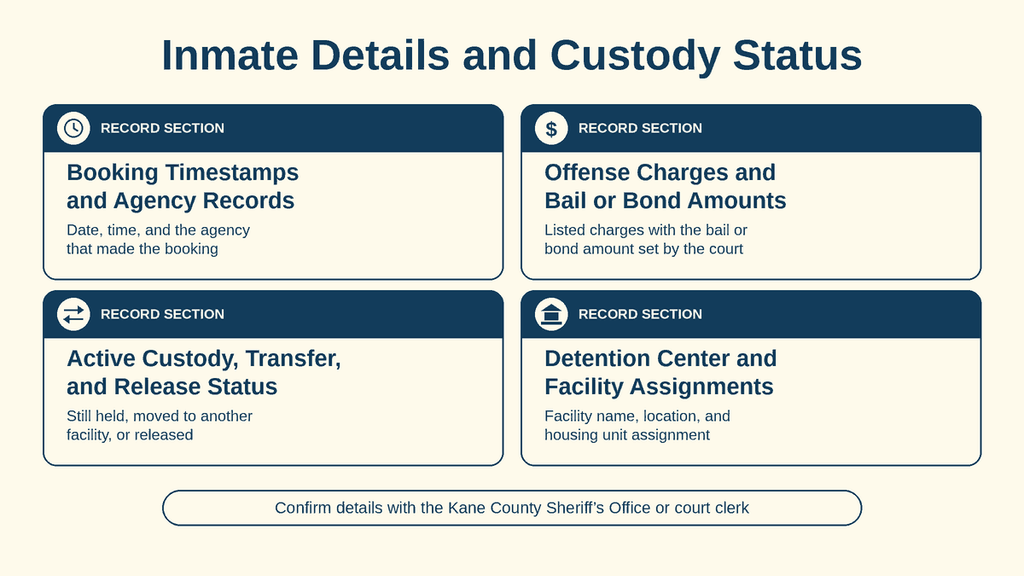
Booking Timestamps and Agency Records
The booking date and time mark the jail’s recorded intake. They can differ from the arrest time, the first court appearance, or the start of a sentence. A person arrested earlier may reach the jail later, and a court event can occur after the booking. Read the timestamp as a jail event rather than a complete timeline for the case.
The agency field identifies the organization connected to the booking. It does not explain every part of the arrest or court process. An arrest record can carry the arrest time and originating police agency, while a jail booking record can show the agency connected with intake. A complete arrest narrative may sit outside the jail roster, so request that record from the agency that created it.
For a recent booking, capture the exact date, time, agency, and booking number. These values are more useful than a common name when staff need to find the right row. They also help distinguish a delayed roster entry from an incorrect search term or an intake recorded under a different name spelling.
Offense Charges and Bail or Bond Amounts
Charge wording on a roster comes from the jail’s intake record. It may use a complaint, charge, alleged offense, or commitment description rather than the exact wording used by the court. One entry may also contain more than one charge. The listing identifies what the jail recorded; it does not establish guilt, innocence, a conviction, or the final case outcome.
The bail or bond amount is the financial figure shown for that booking. Its presence does not prove that the amount was posted, denied, refunded, forfeited, or satisfied. A bond status may change before the next roster publication. Check the status and date beside the amount rather than reading the number by itself.
For formal charge wording, hearing dates, court orders, or case disposition, use the court case record. For the jail’s own intake wording, ask the Adult Justice Center/Jail for the relevant booking report. Keeping these records separate prevents a court charge from being confused with a jail charge or a bond figure from being treated as a final payment.
Active Custody, Transfer, and Release Status
Custody status describes the jail’s administrative handling of a booking. An active-custody entry means the jail lists the person under its custody at publication. It does not show the seriousness of the charge, the length of a sentence, or whether the person has been convicted. A booked person can remain active while the case is still pending.
A transfer note records movement between jail facilities or units. The person remains in custody, so a transfer can change the facility assignment without ending the booking. A release entry records a release event, but formal release processing and removal of a roster row can occur at different times. For that reason, the status field and release date should be read together.
Newly booked inmates may appear with active status after intake processing begins. Recent-intake entries can lag behind the jail’s working record during that process. The listing is still useful for a first match, yet a same-day question about physical custody deserves confirmation from the Adult Justice Center/Jail.
Detention Center and Facility Assignments
A facility assignment identifies the jail or unit shown for that booking. It does not mean the person’s home address, legal residence, workplace, or owner of a listed phone number. A transfer can change the assignment without changing the booking number or inmate ID.
The Kane County adult listing covers the Adult Justice Center/Jail. If a person has moved to another facility, the roster may show a transfer note or a new assignment after the next publication. A daily roster cannot confirm a person’s physical location at a specific second, so use the official jail contact for a same-day location or custody check.
Jail Roster Compared with Other Record Types
Search terms such as jail records, booking reports, arrest records, and mugshots point to different records with different purposes. A jail roster is only one part of the record trail. Identifying the right record prevents a requester from treating a photo, an arrest event, or a court case as proof of current jail custody.
A booking number is usually the best bridge to jail documents. Arrest numbers, inmate IDs, and case numbers may use different numbering systems, so one should not be guessed from another. When requesting a record, name the type needed: use a roster or booking record for jail intake and custody, an arrest report for the police event, a mugshot record for the image, and a court record for legal case events. The Adult Justice Center/Jail can confirm which category its office holds.
Public Availability and File Disclosure
The online roster is the quickest public source for a listed adult jail entry, but it does not replace an underlying jail file or a full case record. Availability can differ by record type, the requester’s purpose, and applicable law. Use the online result for the first match, then ask the office for a specific record when a document, certified copy, or status check is needed.
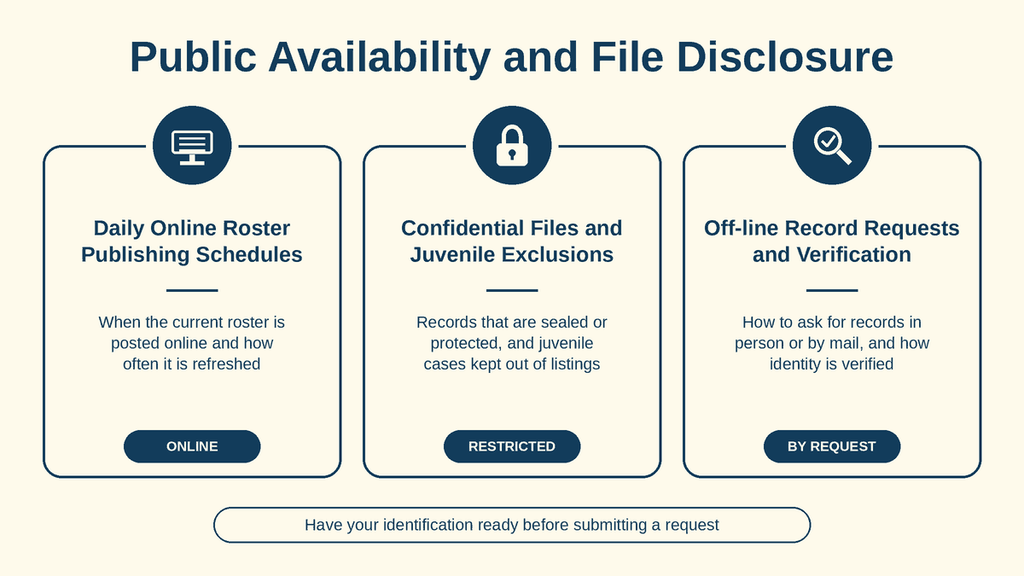
Daily Online Roster Publishing Schedules
The Kane County online jail roster follows a daily publishing cycle. A daily roster is not a continuous live feed. An entry can represent a booking or status change made before the latest publication, while a later event may not appear until the next cycle. The roster date and the event timestamp answer different questions: one shows when the list was published, and the other shows when the jail recorded an event.
A booking made late in the day may wait for the next publication before appearing. For public reference, official inmate search listings indicate that a release processed near publication time can remain on the list with an old status for one cycle. People checking a recent jail booking should look again after the next daily update before treating an absent row as a failed search.
Daily publication also means the roster contains more than bookings made that day. It can include people booked on earlier dates who remain listed for custody. Use each row’s booking date and status rather than treating every name on the list as a new booking.
Confidential Files and Juvenile Exclusions
The public roster covers the adult detention system. A juvenile detainee should not appear in this adult jail listing, and juvenile records follow separate court and confidentiality rules. A missing adult-roster result does not prove that a juvenile record is absent or unavailable through the proper juvenile process.
Public availability of a roster row does not make every related file public. An underlying inmate file may contain restricted details, while an arrest report, booking report, and mugshot may be maintained as separate records. Ask for one named record at a time and let the office determine what may be released under Illinois public-records law.
Off-line Record Requests and Verification
An off-line request works best when it identifies the record and the booking without asking for a broad collection of unrelated material. Before sending personal details, call the appropriate office to learn its accepted request method. Have the most precise identifiers available and state the exact result the requester needs.
- Record sought: Name the current roster, booking report, inmate record, arrest report, mugshot, or certified copy that the request concerns.
- Identifiers: Provide the booking number or inmate ID when known. Add the full name and any spelling variation used by the booking agency.
- Intake context: Include the booking date and time, booking agency, and listed facility to help staff locate the correct event.
- Copy type: Ask whether a view, ordinary copy, or certified copy is needed and which format the office provides.
- Status question: Quote the exact conflicting field, such as an active status beside a past release date, and state what should be checked.
- Fees and request method: Ask whether a fee applies, which payment method is accepted, what form is required, and how long the office can take to respond.
Keep a copy of every request, receipt, and written response. A request reference can prevent a later inquiry from being treated as a new request with no prior history. If the jail cannot provide the requested material, ask which agency holds it rather than accepting a mismatched roster or arrest record as a substitute.
Record Accuracy and Resolution
A daily public listing can show short delays, duplicate bookings, or a row that has not been removed after a release. These conditions do not automatically mean the underlying jail record is wrong. They do mean that a conflict should be checked with exact identifiers, the roster date, and the event involved.
System Delays for Recent Intakes
A new jail booking passes through intake, data entry, and review before it can reach a public list. A recent booking may not appear during that work. The absence of a row can also result from a name spelling that differs from the one used by the booking agency. Neither case means that the person was never booked.
Search once more with the booking number or inmate ID. If one full daily cycle has passed and the entry remains missing, contact the Adult Justice Center/Jail with the intake date, time, agency, and any number supplied by the booking source. This gives staff a direct path to the record instead of relying on a broad name search.
Do not use a failed search as proof of release, transfer, or arrest. The person may be newly booked, listed under another name, or held in a status the roster has not yet captured. A direct custody check is the proper resolution when the person’s location matters that day.
Post-Release Listing Removal Timelines
Recording a release and removing a public row are separate steps. The status field may show a release before the row disappears, or an older row may remain through the next publishing cycle. Check the status and release date together. A row that says “released” should be read differently from one that still says “active.”
If a release date has passed but the status remains active, note both values and the date of the lookup. That conflict may be an update delay, but it should not be corrected by assumption. Ask the jail to verify which field was current at the time of the request.
A roster entry should not serve as the sole proof of release for a court deadline, employment decision, travel check, or other high-stakes purpose. Keep the request receipt, written confirmation, or certified record supplied by the responsible office.
Unlisted or Conflicting Roster Entries
Search problems usually fall into a few clear patterns. Use the pattern to choose the next check rather than repeating the same name search. A short record of the date, search terms, and conflicting field makes the resolution request easier to handle.
Save the roster page date, the exact search term, and any booking number used for a disputed result. If the page provides a printed date or visible update time, retain that value too. These details help staff separate a search mistake from a missing row, an update delay, or a conflicting record.
Jail Roster Verification Checklist
A short verification routine can prevent an unrelated booking from being used. Complete each item that applies to the request, then keep the results with the booking or case documents.
- Open the entry through the official Corrections and Custody page rather than relying on a cached page or an old search result.
- Write down the exact name, booking number, inmate ID, booking date and time, booking agency, facility, and status shown.
- Compare those values with a booking receipt, agency confirmation, or another trusted source before drawing a custody conclusion.
- Read charges as intake wording and the bond amount as a displayed figure; neither field decides the legal case outcome.
- For a record request, state the record type, requested copy, booking identifier, and the precise status question in one message.
- For a conflict, include the roster date, lookup time, conflicting fields, and search terms so the jail can trace the correct row.
Keep any written status confirmation with the source used for the original search. This creates a clear chain from the public roster entry to the official response and reduces the chance that an old row will be mistaken for a current one.
Contact Information
Call during the posted office hours for custody status checks, record questions, and booking verification. For a written file request, ask for the approved request method before sending documents. Have the booking number or inmate ID ready so staff can locate the correct record.
- Adult Justice Center/Jail: 630-232-6677
- Sheriff’s Office: 37W755 Illinois Route 38, St. Charles, IL 60175
- Office hours: Monday-Friday, 8:00 a.m. to 5:00 p.m.
Frequently Asked Questions
The jail roster lists people currently held in Kane County detention facilities. It helps families, attorneys, and community members confirm where an inmate is housed, see booking details, and learn how to contact the jail. The roster updates several times daily, making it a reliable source for recent inmate information.
How can I find a current jail roster for Kane County?
Visit the Kane County Sheriff’s Corrections page and click the “Jail Roster” link. You can search by name, booking number, or inmate ID. The results show the inmate’s name, age, booking date, charges, and assigned facility. Use the phone number on the page for assistance if a record does not appear.
What information does a jail roster entry include?
Each entry displays the inmate’s full name, booking number, date of birth, booking date, listed charges, custody status, and the jail location. Some records also note bond amount and release date if set. This data lets you verify identity and understand the legal situation.
Can I look up an inmate by booking number on the online jail roster?
Yes. On the roster search box, select “Booking Number” and type the exact number. The system returns the matching record instantly. If the number is recent, allow a few hours for the roster to refresh before searching again.
Why might a recently booked inmate not appear on the jail roster?
The roster refreshes every four hours. A new booking may take up to that time to show. If the inmate still does not appear after 24 hours, contact the Adult Justice Center at 630‑232‑6677 to confirm the entry and ask about any data issues.
How do I verify an inmate’s release status using the jail roster?
Search the inmate’s name or ID. If the roster shows a release date or a status of “Released,” the person is no longer in custody. For the most recent updates, call the jail directly. They can confirm whether a release has been processed but not yet reflected online.